I Can Still See It
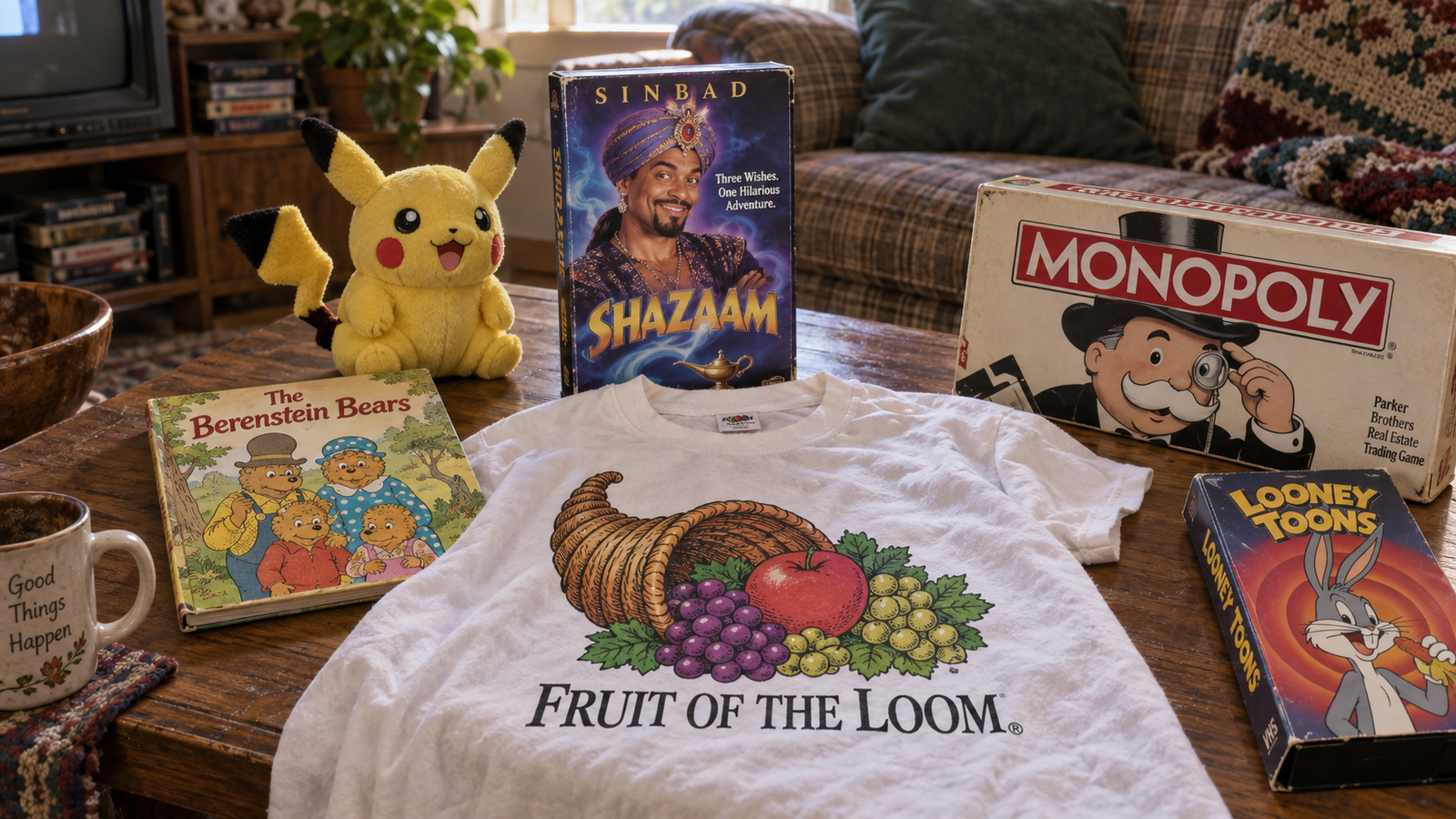
Berenstain, not Berenstein. “No, I am your father,” not “Luke, I am your father.” Pikachu’s tail is yellow all the way to the tip. Looney Tunes, because the shorts existed to sell sheet music. There is no Sinbad genie movie called Shazaam; there’s a Shaq movie called Kazaam, and a 1994 marathon Sinbad hosted in a genie costume, and that’s the whole of it.
And the Fruit of the Loom logo has an apple, grapes, currants and leaves, and has never had a cornucopia behind them.
In 2022, YouGov asked Americans about that last one. 55% said the logo included a cornucopia. 21% got it right. The wrong answer won by better than two to one.
Where the name came from
In 2009, at Dragon Con, a paranormal researcher named Fiona Broome fell into a conversation with someone who also remembered Nelson Mandela dying in prison in the 1980s. Broome remembered it too: the news coverage, the mourning in South Africa, a speech by his widow. She wrote it up and put a website up the following year, and the phenomenon got her name for it.
Mandela walked out of prison in 1990, won the Nobel Peace Prize in 1993, served a term as president, and died in December 2013, at home, an old man.
The CERN business came later, and it’s date-matching. The Large Hadron Collider fired its first beam in September 2008. It shut down in 2013 and came back on April 5, 2015, with 13 TeV collisions following in May. People who felt the world go strange around either date found a machine to hang it on. CERN’s own answer to the general “are you going to break something” question is that cosmic rays have been slamming into the atmosphere at higher energies for billions of years, roughly a million LHC experiments’ worth, and the planet is still here. I couldn’t find any statement from CERN addressing the Mandela effect specifically, which figures. It’s not their department.
Here’s the part that amuses me. The machine is off now. Run 3 finished this summer—last proton collisions in May, beams down on June 27—and the LHC won’t run again until around 2030. So we’re due four quiet years. Not that it settles anything: nobody can date the moment a memory diverged, so a fresh one surfacing in 2028 wouldn’t prove the machine was innocent. It’s the closest this business gets to a prediction, and even that one leaks.
From the inside
Here’s mine, and I’m aware of what I’m about to sound like.
There was a cornucopia. I can see it: the brown wicker horn behind the fruit, the way it tapered off to the left. I know what the company says. I know what the trademark filings show. I can see it anyway.
I have two Mandelas. One died in prison and I remember it being sad and far away and not very surprising. The other walked out, went grey, became a kind of secular saint, and died old. Both have the texture of memory rather than of something I read. Only one of them happened.
I remember Odie with spots, one on either side. And there’s a man whose death I remember hearing about years before he actually died.
Then there’s the other thing, which is harder to put in a sentence. Every so often the room goes wrong. Not frightening, not hallucinatory. Everything is where it was and none of it is right, like a photograph of your own kitchen taken by somebody else. It lasts a minute or two and stops. This has been happening for decades, at the same rate, through every other thing that’s happened to me. It has a name, derealization, and depending on how you ask the question, somewhere between a quarter and three quarters of people report having experienced some version of it.
And I dream about adjacent worlds. Not fantastical ones: ordinary life, slightly off, and I’m in them as an observer rather than a participant with any say. A family friend, in one of those dreams, hadn’t caught a health problem in time and died of it. In this world he’d caught it two years earlier and was fine. A few weeks after the dream, he died of a brain aneurysm. In the dream there was a sense of distance, as though that world sat close to this one while others sat further out. The close ones kept arriving. The far ones never did.
I want to be careful here. I didn’t write any of it down beforehand. There’s no dated record, no sealed envelope, nothing that would count as evidence to anyone, including me. What I have is a memory of a dream and a memory of a phone call, and I know what those are worth, because of everything below.
What memory actually does
Memory doesn’t play back. It reassembles, every time, out of whatever is lying around.
In 1974, Elizabeth Loftus and John Palmer showed people film of a car crash and asked how fast the cars were going when they hit each other. Except for some subjects the verb was smashed, and for others collided, bumped, hit or contacted. The estimates tracked the verb: 40.8 mph for smashed, down to 31.8 for contacted. In a second experiment, participants came back a week later and were asked whether they’d seen any broken glass. There was none in the film. 32% of the smashed group remembered it, against 12% of the controls. One word, asked once, put glass in a memory that never had any.
Where a memory came from turns out to be a separate problem. Memories don’t arrive labeled. The brain infers the source from the qualities of the thing itself: how vivid it is, how much perceptual detail it carries, how it feels to recall. Which means something you imagined clearly, or read once, or heard someone describe well, can get filed as something you saw.
And memory is catching. In one experiment, participants viewed household scenes alongside a partner who was working for the researchers, and during recall that partner mentioned a few plausible items that hadn’t been there. False recall of the suggested items ran .22 against .06 for controls, and higher still for items that fit the room. Tellingly, people mostly reported knowing the item had been there rather than remembering it. The content survived. The source didn’t.
All of that is well established, and it explains an enormous amount. Some of these errors have perfectly ordinary explanations: Berenstein is the commoner spelling, Toons is the sensible pun. It also explains why this clusters where it does. Logos, cartoon tails, a single line of dialogue: things everyone saw constantly and nobody ever looked at closely. That’s the zone where reconstruction has the most room to work and still comes out feeling like recall.
Why the same mistake?
Here’s the part that keeps me interested.
In 2022, two researchers at the University of Chicago ran four experiments on what they call the visual Mandela effect. Forty well-known icons, 260 participants. Seven of those icons were identified correctly 33% of the time or less.
What makes it strange isn’t that people get them wrong. It’s that people get them wrong the same way. Shown several variants, they don’t scatter across the wrong options; they converge on one particular wrong version, and they’re confident about it. Asked to draw the icons from memory, with nothing in front of them, they produce the same errors spontaneously. Measures of where people looked didn’t account for it. Neither did how much exposure they’d had to the real images.
And the familiar-association explanation doesn’t cover it either. The researchers make the point with our cornucopia: a plate is far more commonly associated with fruit than a horn of plenty is, so a brain filling in from the nearest template should be producing a plate. It doesn’t. It produces the cornucopia.
Their own conclusion is that there may be no single cause, that different images may do it for different reasons. That’s a statement about memory having several mechanisms, not a statement that memory science has hit a wall, and I want to be straight about that, because the temptation is to read “we don’t have one explanation” as “so it could be anything.” It couldn’t. But it does leave a real question on the table, asked by the people whose job is asking it: why the same mistake?
The outcome recurs, the mechanism never does
Back to the dreams, because there’s a pattern in them I can’t argue my way out of, and it doesn’t say what I’d like it to.
In the dreamt world, the man missed the diagnosis and died of the illness. In this one he’d caught it, two years earlier, and was well. Weeks after the dream he was dead of something with no relationship to any of it. The death arrived. The thing the dream appeared to be about—the missed diagnosis—was the one part that had already not happened.
That’s the shape as I remember it. The outcome recurs. The mechanism never does.
Which is what I’d expect if it were prediction rather than observation. If I were watching a world next door, the details would match sometimes. A car, a road, a date. What matches instead is the conclusion, and a conclusion is the kind of thing some part of me could have reached on its own, out of the hundred small things a person takes in without filing: the color of someone’s face, the pauses, what nobody is saying. That part doesn’t get to speak in sentences. It builds a scene, and a scene needs a cause, so it invents one.
But I have to put that word remember back in the sentence and leave it there. I kept no record of the dreams that led nowhere. I never wrote down, in advance, what would count as close. The pattern is itself something I’m recalling after the fact, which means I’m using memory to adjudicate a question about memory, and that’s not an instrument I can trust here. There’s even a name for the neighboring experience, déjà rêvé, the sense of having dreamed a thing before, and a literature on how easily dreams and waking events get confused in recall. Which is to say: this isn’t unstudied ground, and it isn’t ground that supports what I’d prefer.
The same discount applies to the distance. The near worlds were the ones that came true; the far ones never did. I can tell you what that distance felt like. I can’t tell you what it tracked, because the only witness is the same faculty that’s on trial.
The physics, taken seriously
The people who believe in timeline shifts usually reach for quantum mechanics, so it’s worth saying what the theory actually claims, because the pop version and the real one aren’t close.
The many-worlds interpretation comes from Hugh Everett in 1957, and it’s a serious position, not a fringe one. The claim is that the wave function never collapses. Every outcome of every quantum event is realized, and what we experience as a single result is one branch of a universal wave function containing all of them. No dice, no collapse, no special role for the observer.
The reason you can’t visit is decoherence. Superpositions persist only while a system stays isolated. The moment it interacts with its environment, which anything larger than a few particles does constantly, interference between the alternatives becomes inaccessible in any practical sense. That’s what makes them separate branches. Testing the interpretation would mean observing interference between branches at macroscopic scale, which is not a thing current physics can do.
There’s a deeper problem with “a nearby timeline,” which is the phrase doing all the work in every version of this I’ve ever argued, my own included. Branch separation isn’t spatial. The state space of quantum theory has plenty of mathematical structure, but its distances aren’t distances in any place you could walk. A branch that resembles ours isn’t sitting a short way off. There’s no direction to travel and nothing to travel through. The intuition of a world just over there is borrowed from ordinary space, and the framework that supplies near-identical worlds is precisely the one that doesn’t supply a distance to cross.
Brane cosmology does offer real spatial separation: extra dimensions, parallel sheets, our matter confined to one sheet while gravity leaks into the bulk. That’s mainstream physics too. It’s the reason for the torsion-balance experiments that hunted for departures from the inverse-square law at very short range, down to 52 microns, where they found ordinary Newtonian gravity and nothing else.
Rovelli is worth asking about this because he’s partly why people invoke it. He writes the popular books arguing that time isn’t fundamental, and his relational quantum mechanics holds that a system’s properties are defined relative to an observer rather than absolutely. Both get borrowed by people who want different observers to have different histories. When Amelia Tait put the believers’ quantum theories to several physicists for MIT Technology Review and asked Rovelli whether he had thoughts about them, he said: “Yes, definitely. They are all total bullshit!” He added that it’s one of the few things he feels totally convinced about. David Deutsch, who champions many-worlds harder than almost anyone alive, said none of them follow from quantum theory or amount to rational speculation beyond it.
The argument I keep having with myself
I had this out in writing recently, which I’d recommend to anyone with a belief they’re fond of.
Every time an objection landed, I swapped the mechanism. Consciousness crossing over? Fine, the whole body crosses. No transport process? Fine, call it a phase change. A phase change would alter the memories too? Fine, make it slight enough that nothing else is touched. Each version dodged the last objection. That isn’t reasoning toward a conclusion. That’s a conclusion holding still while the supports get replaced underneath it, and I could watch myself doing it while I did it.
The rest of the case against is simple and hard to get around. The errors run toward the tidier version more often than a random crossing would produce. The physical record never moves: the old packaging in the landfill still says Berenstain. And the hypothesis absorbs every piece of evidence you feed it, which is a reason to hold it loosely rather than a point in its favor.
What I still can’t make go away: people produce the same specific error, confidently, drawing on an empty page. The researchers who study it don’t have one explanation. And I have a gradient in my own dreams that behaved like a measurement, which I can neither verify nor forget.
Still there
I know how memory works. I’ve read the studies, I can recite the numbers, and I’ve just spent two thousand words laying out why the ordinary explanation is almost certainly the right one.
The evidence points at memory. I understand why.
The cornucopia is still there when I close my eyes.
Knowing a memory is wrong and not having it anymore turn out to be two different things.
Discover more from Perhapsery
Subscribe to get the latest posts sent to your email.