Who Am I Now?
As men, we’re taught to define ourselves by our roles: son, brother, father, husband. We further define ourselves by our purpose and how we fulfill it. That includes managing a career to provide. This is how men have been raised for generations.
But what do we do when every role we inhabit is ripped away from us?
When we lose everything, we’re left with…still something, but it’s not what we know. And that’s a problem.
I have now lost every single thing I used to define myself. Health, career, wife, family, finances, even my home. What I’m left with is a preponderance of time to…well, ponder. All that remains is the contemplative.
That and my memories. Those are perhaps the most painful thing of all. It’s not all bad, of course, but that is where the mind goes naturally.
Escape is the first line of defense, but decades of entrenched conditioning don’t give way easily. One can “reinvent” themselves, but that’s just a rehash of what set this up in the first place.
Then there’s the old life. It’s comfortable—it’s what you know—and that’s very alluring. Often it really is available for a return. But once you’re away from it, you realize the insufficiency of what came before (if not the blatant façade). You cannot unsee what has been seen. Knowing what you know…would you really?
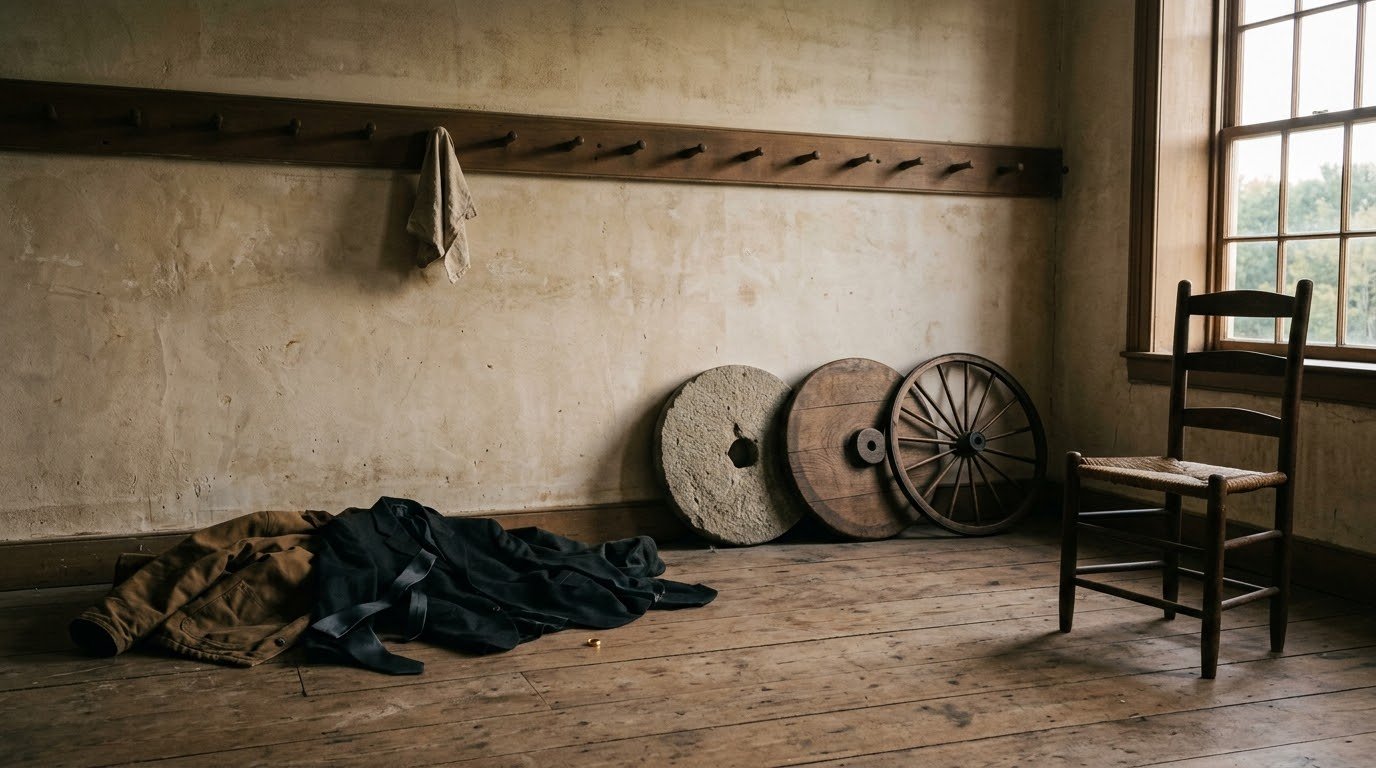
Reinventing is exactly that: re-inventing. We follow the same process we followed in the previous iteration, and the one before it. We reinvent the same wheel. Maybe this one is made of wood instead of stone, covered with rubber rather than bare, bespoked instead of solid…but it’s still a wheel.
What’s left when the old one comes off is something stripped of all the clothing, armament, and decor we apply over the course of a lifetime. It’s raw and real. What to do with that? Dress it back up again, or…nothing?
Not all of the dressing is ours. Much of it is applied by others, and we accept it, walk with it, and eventually become it. I’ve been told many times that I should teach. Become a rabbi, a schoolteacher, the one who does speaking engagements and online classes. I have repeatedly resisted.
Why? I know I would make a good teacher of things. I’ve done it before, many times, and I generally enjoy it—at least until the students stop learning what I want them to learn. There’s an egoistic trap in it. The trappings of leadership come with grandeur and delusion, and those interfere with the greater work, which is learning and becoming. So I turn down the very suggestion.
Even naming what remains carries the same risk. Call it “the contemplative” and the word can become the next garment. But one can’t describe or discuss without words. We can live without them; we can’t have the conversation without them. The important thing is to recognize the word as a natural function of the core and keep it there, without adding the dressing: guru, teacher, mystic, eccentric, ascetic.
So…what to do with the new circumstances? Self-help? A support group? Start over and build something altogether new?
Or…do nothing?
Doing nothing is both surrender and peace. That life is gone. The past is out of reach. Maybe the better course is just to see where things go on their own. No shaping the future, no pushing things in a certain direction. Just watch and respond. Or not. The Taoists called it wu wei.
But even not building is an action, and if you want to eat, to have shelter—to live—you need to do things like make money. So we build. The key is keeping what is built apart from who we are. Build, without staking your identity on what you build.
Building to sustain life and building to establish worth are two different things. The second is external. It is, once again, the ego expressed. It goes into comfort, standing, prestige, luxuries that run from the seemingly basic to the extravagant. Each of us decides what we’re willing to accept, and that is precisely where the constructed self thrives.
We wax poetic about the joys of simply sitting in a chair reading, at a campsite, by a lake in the middle of nowhere, with no one anywhere near to bother us. The joys of solitude. The peace of quiet. And yet we work for the money for the big house, and take the occasional vacation to do what we say we enjoy.
There’s all this talk of work-life balance. I say they should be out of balance, just not the way we’ve been taught to believe. Work should be the lesser of the two. And life does not equal play. It’s the becoming—the learning. Some may see that as part of work. I would argue it’s what we’re here for in the first place.
I do not want to return to what I once was. I miss the roles, true. I miss the recognition and reward that came from living each and every one of them. But a role we inhabit is not the true expression of the self. The identity I built on them was a façade—not true, not real—and that is simply not what I want. Living them was necessary for me to understand that what I thought I wanted wasn’t what I really wanted, or needed.
Now…a sense of clarity has overtaken purpose.
Writing doesn’t escape the trap either. It removes the student from the room, but the imagined reader remains. I still want recognition and approval. Crave it, even. Who doesn’t like hearing good things about themself?
So what is the writing actually for? I write these pieces to sort through a lot of very complex things, some internal, some external. I’m not writing for other people, not really. I’m writing for myself.
Which means I’m still teaching. Still putting myself out there, only without the classroom’s feedback loop and, more importantly, in a self-instructive fashion. The teacher who does not learn in his own class is missing the opportunity of a lifetime. Sometimes, explaining the way I feel, think, and act is pedagogical in and of itself.
Others may happen upon it, find it useful, and carry it forward. Someone else won’t. The publishing is the part that’s for others, and that’s where the wanting lives.
Discover more from Perhapsery
Subscribe to get the latest posts sent to your email.