The Path of the Solitary Man
A man who has undergone trauma, beaten back the forces that seek to put him down, learns to walk the path of the solitary man.
There are two ways out of the kind of years I’ve had. You collapse into a ball of goo, or you come out the other side. But coming out the other side splits again, and from a distance the two roads look the same.
One is self-reliance. The other is armor.
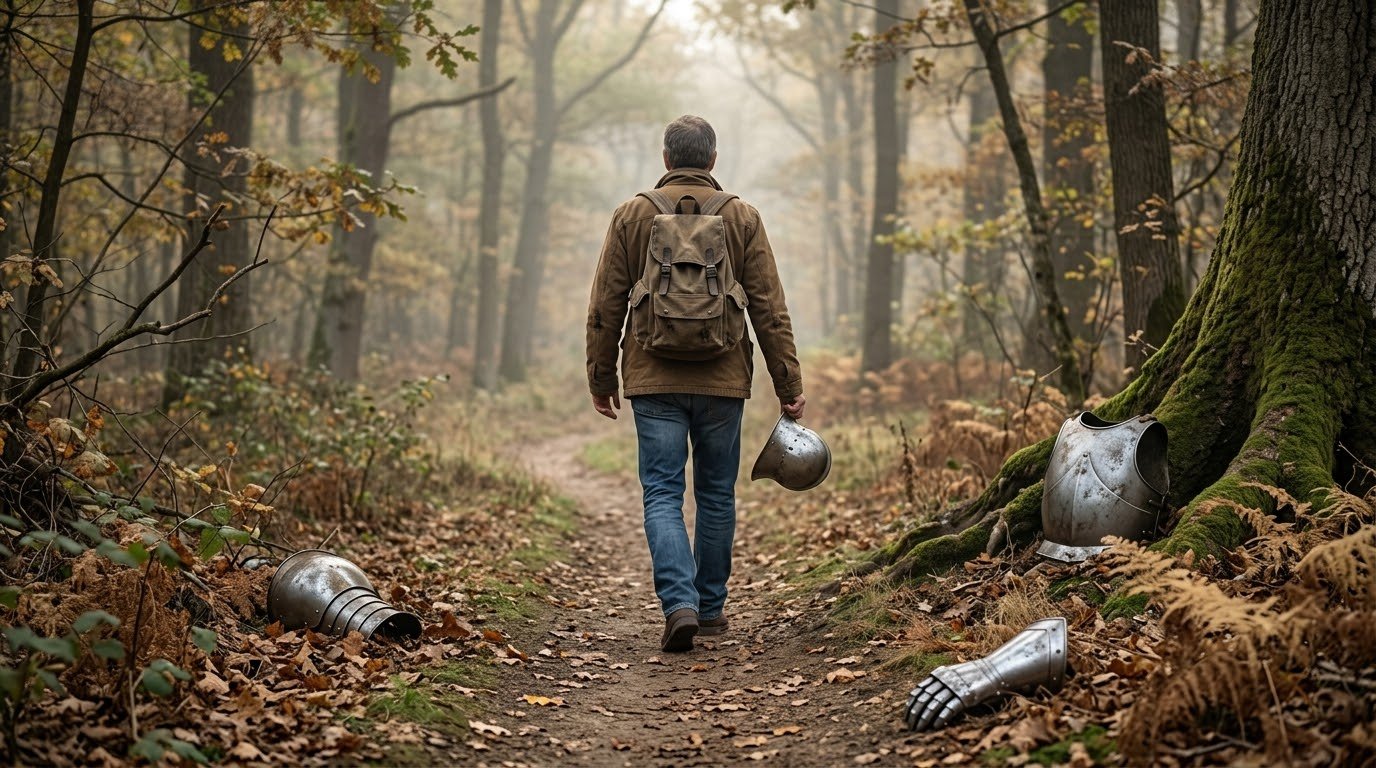
Armor is what people see and mistake for strength. The armored man doesn’t need anyone, because needing someone is what got him hurt. He’s an armored tank on the road: plating on the outside, and inside, utter chaos and disarray. The trauma never healed. It just got a shell.
That’s the version that worries me, because of where it can end up. In the U.S. in 2023, men were about half the population and nearly 80% of the suicides, at roughly four times the rate of women. I’d bet a lot of them looked like they had it handled.
What trauma teaches you first is something about other people.
There are people who will be there when things really collapse. Even they are limited in how much they’ll give, but they’ll give quite a lot. Then things settle, and the ordinary needs arrive: the repair you can’t do yourself, the boxes that need moving, the uncomfortable errand nobody wants to stand next to, the favor that takes a minute a day. And the same people are nowhere to be found.
Then there’s the inverse: the one who’s there for the mundane and gone when it counts the most.
Put the two together and the lesson is that showing up once doesn’t make someone dependable. I don’t think it’s simple convenience, either. People help when the help means something to them. A crisis carries meaning; being the one who came through when it mattered says something about who you are. Ordinary need carries far less. It’s a Saturday afternoon and a chore, and nobody remembers having done it.
To be fair, the asks aren’t free. A Saturday is a Saturday. But being left with a problem for months isn’t free either, and only one of us pays for that.
Why men, and why now?
Men have a long record of leaning on each other. Achilles weeps over Patroclus. David grieves for Jonathan: “Your love was wonderful to me / More than the love of women.” Men wept, embraced, and held each other up, but they did it among men. The camp, the guild, the lodge, the crew. The guys you worked a line with for thirty years.
Those spaces have mostly fallen away. In 1990, 3% of American men said they had no close friends; by 2021 it was 15%. The share of young men who turn to a friend first with a personal problem fell by half, from 45% to 22%.
Into that gap came new advice. Open up. Talk about it. Ask for help. For a generation now men have been told to think different, act different, be different, and the reception hasn’t caught up. When a man shows weakness, the sharks sense chum in the water.
Sometimes the sharks are other men; we’re trained that way. But the cruelest version is the one who asked. The partner who wants him to open up, to trust her with what’s going on inside, and then turns away from what he shows her. Brené Brown, who studies shame, tells of a man at a book signing who said of his wife and daughters, “They’d rather me die on top of my white horse than watch me fall down.”
So the advice changed and the audience changed, but the punishment didn’t. Women are about twice as likely as men to say they often talk with close friends about their mental health. That isn’t because men have nothing to say. When a woman says she’s struggling, she’s asking for help. When a man says it, he’s too often heard as weak.
Layer that onto how boys are raised and what’s expected of them, then tell them to be something else entirely. That’s a violently disruptive change, and I don’t think the fabric of common manhood was built to absorb it. Boys especially are left exposed.
There’s a push now among men to fix this. Andy’s Man Club in the UK, free, peer-run, and for men only, under the banner “It’s Okay To Talk,” runs more than 370 groups a week. I don’t see that as the opposite of the solitary path. It’s the old camp rebuilt: a room where a man can talk without the sharks circling, because everyone in it is there for the same reason.
As for the path itself: you stop counting on help being there. You have to be ready, willing, and able to do it on your own. If someone helps, that’s great: it just means you get to do something else on your list.
Self-reliance has limits, though. Sometimes the skill or knowledge required is beyond you. You ask, the help doesn’t come, and you muddle through while the problem stays. There’s a check engine light on my dashboard that’s been lit for a long time. It isn’t going off until a part gets replaced that I can’t replace myself. I keep driving. That isn’t dependence. It’s what self-reliance costs: the problem sticks around until I acquire the knowledge, the tools, or the capacity to resolve it.
Over the long haul, being alone is not the same as being lonely. For the armored man, it’s going to turn into loneliness, and likely bitterness. For the man who comes out solid, it’s simply solitude. And for some of us, solitude is peace.
It takes a fair dose of stubborn. But here’s what I didn’t expect. Once you no longer need someone, it becomes much easier to accept them for who they are. The friend who comes for the crisis and not the chore is just that: who he is, not a betrayal. Armor can’t do that. Armor keeps the ledger and still resents. Self-reliance lets the grudge go, because nothing is owed.
Discover more from Perhapsery
Subscribe to get the latest posts sent to your email.